An Overview of Determinacy Axioms
Posted on January 11, 2017
I’ve recently started to read up on descriptive inner model theory, and quickly stumbled across a lot of new axioms. Prime among these were Sargsyan’s $\textsf{AD}_{\mathbb R} + \Theta\text{ is regular}$ axiom. After skimming through Sargsyan’s survey paper I encountered several variants of these “$\Theta$-axioms” and also an axiom called $\textsf{LSA}$ (in the paper it’s actually called $\textsf{LST}$, but the terminology has changed since then).
This post is part of a series on determinacy:
- An Overview of Determinacy Axioms
- Determinacy From Woodins I
- Determinacy From Woodins II
- Determinacy From Woodins III
- From Determinacy to a Woodin I
- From Determinacy to a Woodin II
- The Structure of Games
- Borel Determinacy
- HOD Models of Determinacy
- Limitations of ZFC Determinacy
- Mice and Long Games
I decided to do some intense Googling and a little bit of thinking, and my current overview of these determinacy axioms and their relation to the large cardinal hierarchy looks like this:
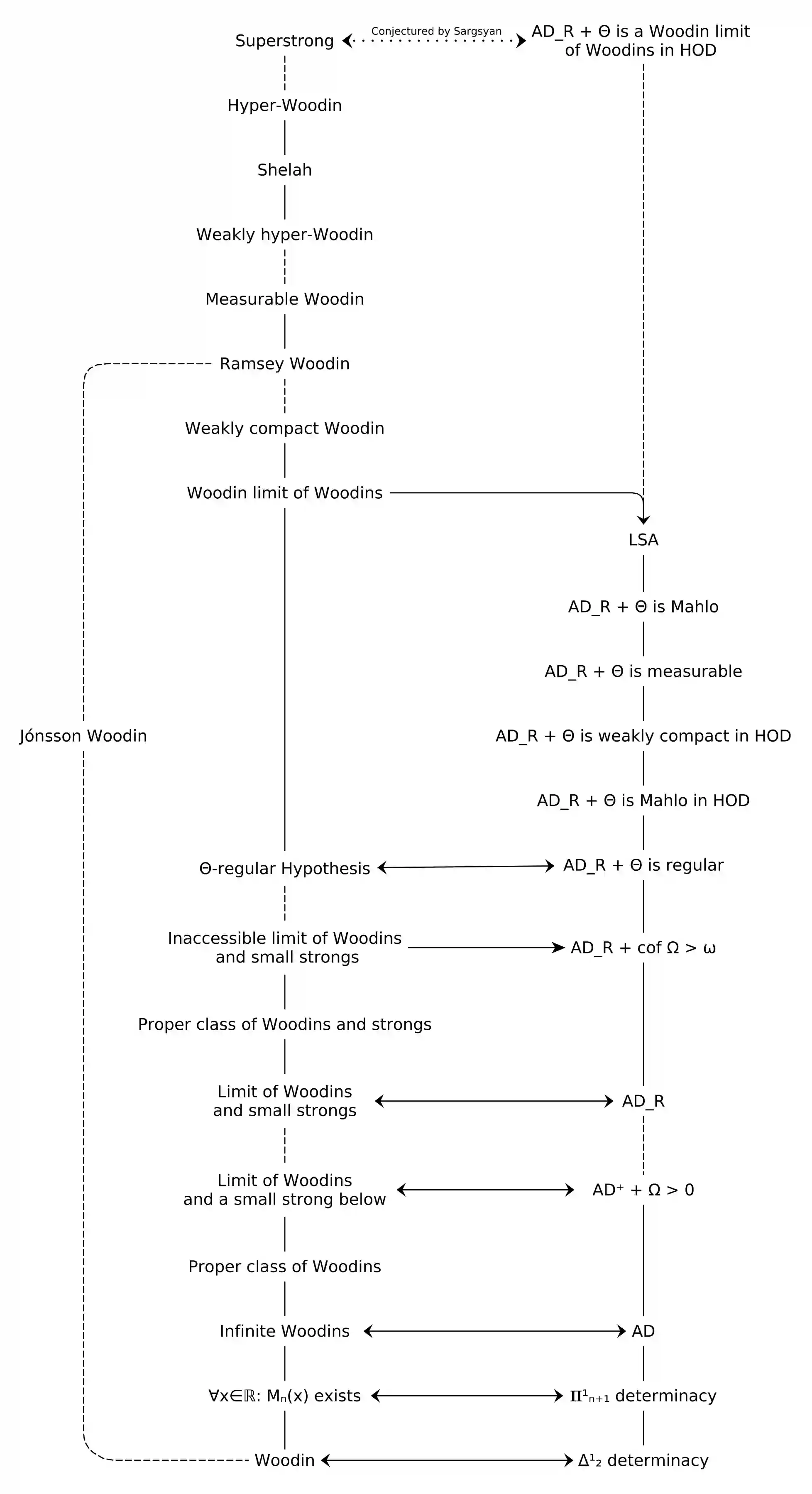
There might be a lot of links that I’ve missed, but this is at least a first attempt. All arrows in the diagram are the usual consistency implications, where I’ve labeled an arrow with a circle if the implication is strict. The hypotheses on the left-hand side all include $\textsf{ZFC}$ and the ones on the right include $\textsf{ZF}$. Let me explain what these axioms are, and which results that constitute the arrows.
Starting from the bottom, we have the two well-known theorems due to Woodin that the existence of a Woodin cardinal is equiconsistent to $\Delta^1_2$-determinacy and the existence of infinitely many Woodins is equiconsistent with $\textsf{AD}$. Moving one step up,we get to the statement that there is a cardinal $\kappa$ which is a limit of Woodins and there exists a $<\kappa$-strong cardinal $\lambda$ below $\kappa$ – in Figure 1 I’ve dubbed this a “limit of Woodins with a small strong below”. This is also called the $\theta_0<\Theta$ Hypothesis, or the $\Omega>0$ Hypothesis. It’s a result due to Woodin and Steel that this hypothesis is in fact equiconsistent to $\Omega>0$, where $\Omega+1$ is the length of the Solovay sequence.
Proposition. The existence of a Woodin cardinal $\delta$ and a $\delta$-strong cardinal $\kappa$ below is consistency-wise stronger than a proper class of Woodins.
Proof. The idea is simply to iterate $\kappa$ using the associated $\delta$-strong embedding. As the resulting two models agree about $V_\delta$, $\delta$ is still a Woodin cardinal in the target model, so iterating $\kappa$ out of the universe we leave a proper class of Woodins behind. QED
In particular, as the $\Omega>0$ Hypothesis is strictly stronger than a Woodin $\delta$ with a $\delta$-strong below, the former is strictly stronger than a proper class of Woodins. Moving one step up we get the statement that there is a limit of Woodins and small strongs, also called the $\textsf{AD}_{\mathbb R}$ Hypothesis. Woodin and Steel have shown (around 2009-2012) that this hypothesis is in fact equiconsistent to $\text{AD}_{\mathbb R}$ (see Theorem 2.14 in Sargsyan’s survey), giving us an equiconsistency arrow in the diagram.
Also, given a proper class of Woodins and strongs, we can simply construct a sequence of increasing interleaving Woodins and strongs, getting a limit of Woodins and strongs and in particular this limit also satisfies the $\textsf{AD}_{\mathbb R}$ Hypothesis. As there is an inaccessible above this limit we can also prove the consistency of the statement, making this implication strict.
Moving further upwards we encounter the $\Theta$-regular Hypothesis:
Definition. The $\Theta$-regular Hypothesis is the statement that there is a cardinal $\delta$ which is an inaccessible limit of Woodin cardinals and $<\delta$-strong cardinals and whenever $\Gamma\subseteq\dot{\Gamma}^\delta_{\text{uB}}$ is such that $\Gamma\models"\Theta\text{ is singular}"$ then there is some $\kappa<\delta$ such that $\kappa$ coheres $\Gamma$.
See Definition 2.15 and the discussion just before in Sargsyan’s survey for a definition of coherence, $\dot\Gamma^\delta_{\text{uB}}$ and $\Gamma\models\varphi$. It was then shown by Sargsyan and Zhu (Theorem 2.18) that this hypothesis is equiconsistent to $\textsf{AD}+\Theta\text{ is regular}$.
Moving further up on the determinacy side, we get a lot of $\Theta$-theories, which is proven in to have the given (strict) ordering (Lemma 2.6). We then get to $\textsf{LSA}$:
Definition. The Largest Suslin Axiom (LSA) is the statement that $\textsf{AD}^+$ holds and for some ordinal $\alpha$, $\Theta=\theta_{\alpha+1}$ and $\theta_\alpha$ is the largest Suslin cardinal $<\Theta$.
That $\textsf{LSA}$ is stronger than $\textsf{AD}_{\mathbb R}+\Theta\text{ is Mahlo}$ was shown by Kechris, Klienberg, Moschovakis and Woodin. A very recent result by Sargsyan and Trang (Theorem 10.3.1) shows that a Woodin limit of Woodins is stronger than $\textsf{LSA}$.
With the result of Sargsyan and Trang at hand it is trivial that the top determinacy theory $\textsf{AD}_{\mathbb R} + \textsf{HOD}\models\Theta\text{ is a Woodin limit of Woodins}$ is stronger than $\textsf{LSA}$ as well. Sargsyan also conjectured that this last theory is equiconsistent with a superstrong.
Going back to the large cardinal side we get various “hybrid Woodins”. At the bottom we have an iterable Woodin, or an $\omega_1$-iterable Woodin, where an iterable cardinal is a notion invented by Gitman:
Definition. A cardinal $\kappa$ is iterable if for every $A\subseteq\kappa$ there is a transitive set $M$ of size $\kappa$, satisfying $\mathsf{ZFC}^-$, having $\kappa,A\in M$ and an $M$-measure $\mu$ on $\kappa$, which can be iterated through all the ordinals.
Starting off with an iterable Woodin $\delta$ and letting $\vec E\subseteq\delta$ be a (code for an) extender sequence witnessing Woodinness, we can then find a $\mathsf{ZFC^-}$-model $M$ in which $\delta$ is a measurable Woodin. By iterating it out of the universe, we leave (many) Woodin limit of Woodins behind and end up in a model of full $\mathsf{ZFC}$.
As for the other arrows in the diagram, Gitman showed that Ramseys are iterable and by definition Ramseys are Jónsson. Measurables are also Ramsey by Rowbottom’s theorem. The last steps involve the notion of Hyper-Woodins and Shelahs, where hyper-Woodins were invented by Schimmerling, in which he also showed the given ordering in the diagram above.
One thing to note is the rather peculiar state of a Jónsson Woodin - I’m at least not aware of any upper bound except the trivial Ramsey Woodin one. Even though Jónssons and Ramseys are equiconsistent, a result that is due to Mitchell, Jónssons have a lot lower actual strength than Ramseys, in that they don’t even have to be regular.
As for the current status of inner model theory and descriptive inner model theory, Neeman has built mice containing a Woodin limit of Woodins using “pure” inner model theoretic methods, which is the best result to date. Using descriptive inner model theoretic methods, Sargsyan and Trang has produced certain hybrid mice satisfying $\textsf{LSA}$, which is the current best result on the descriptive side. Whether or not $\textsf{LSA}$ is equiconsistent to a Woodin limit of Woodins or if it’s strictly weaker is not known at this moment, as far as I can tell.
EDIT 1: $\textsf{LSA}$ is strictly below a Woodin limit of Woodins, shown by Sargsyan and Trang - I’ve reflected this in the diagram now.