Core Model Induction
The Pointclass Perspective
Posted on March 31, 2019
Previously I covered the core model induction up to showing that all sets of reals in $L(\mathbb R)$ are determined. In other words, it reached a model containing all the reals satisfying $\textsf{ZF}$ and $\textsf{AD}$, the Axiom of Determinacy. In terms of large cardinal theories, this is equiconsistent with the theory $\textsf{ZFC}$ and the existence of infinitely many Woodin cardinals. I’ll here talk about how to push this even further, getting close to reaching the current state of the art.
This post is part of a series on core model theory:
- What is K?
- Core Model Induction 101
- Applied Core Model Theory I
- Applied Core Model Theory II
- Applied Core Model Theory III
- Core Model Induction: The Pointclass Perspective
But before we go beyond $L(\mathbb R)$ let’s start all the way from the beginning again, with a different viewpoint. That is, instead of focusing on the inner model theoretic aspect, as we did in my previous blog post, we put on our descriptive set theoretic glasses and see the inner model theoretic approach only as a convenient tool to showing that certain sets are determined.
Let’s therefore, once and for all, decide that our goal is to produce a large pointclass $\Gamma\subseteq P(\mathbb R)$ such that every $A\in\Gamma$ is determined. Now, the question of what we mean by “large” appears, since we can’t work with $\textsf{AC}$ in a determinacy context. For now, let’s stick to the intuitive notion and we’ll be more precise later. We can then split our induction into the following steps.
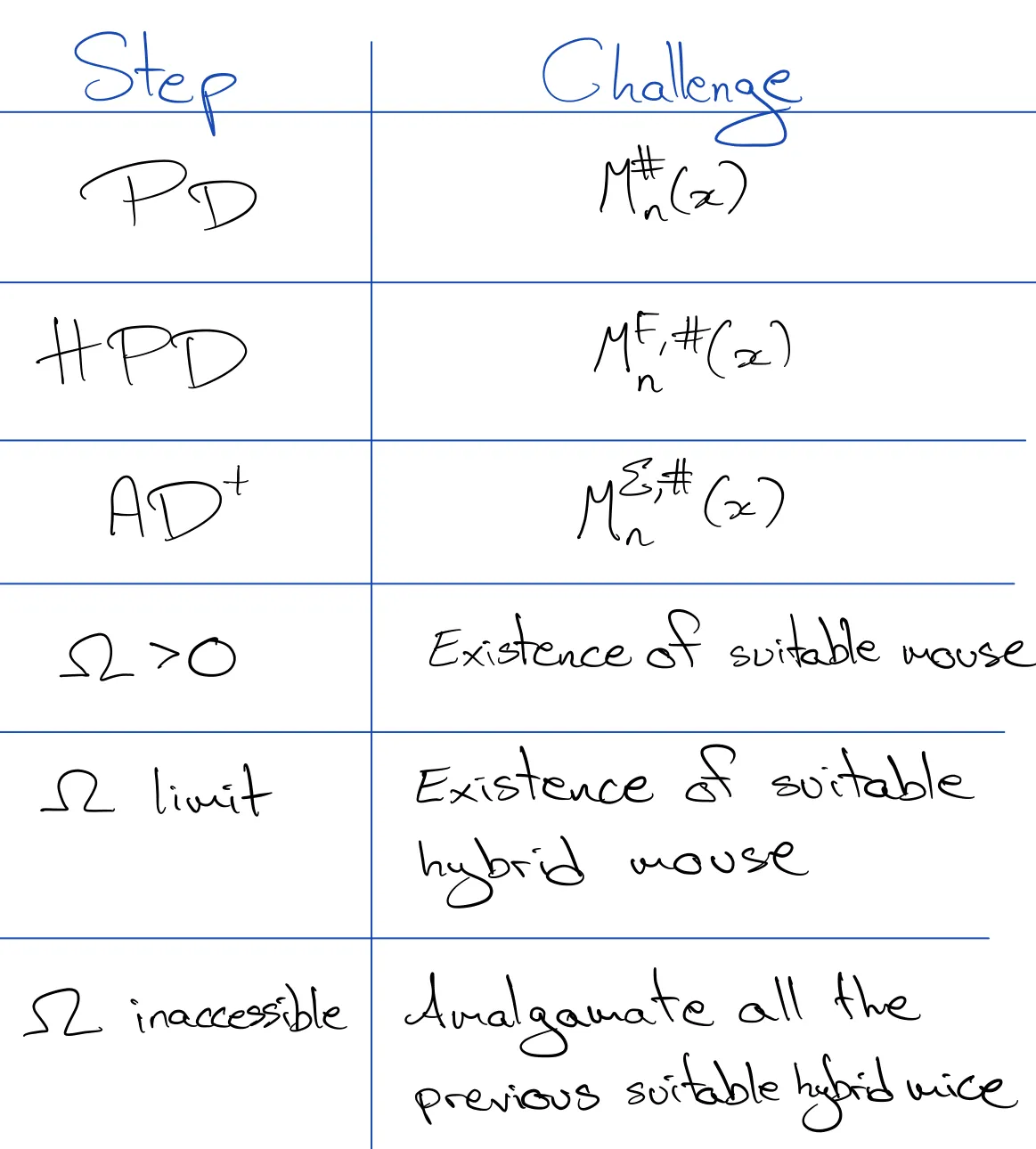
The $\textsf{PD}$ step of a core model induction is when $\Gamma=\bigcup_{n<\omega}{\bf\Sigma}^1_n$, the pointclass of projective sets of reals. A result by Müller-Neeman-Woodin (see Müller’s thesis for a proof) shows that this is equivalent to the existence and iterability of $M_n^\sharp(x)$ for every $n<\omega$ and $x\in\mathbb R$, and we have a (folklore?) result that this is equivalent to showing that the core model $K(x)$ doesn’t exist for all $x\in\mathbb R$.
We have therefore taken a problem of descriptive set theory, showing that projective sets of reals are determined, and converted it into an inner model theoretic problem, showing that $K(x)$ doesn’t exist for all reals $x$. To complete this step we therefore use our hypothesis to contradict the existence of such core models.
Our goal and interest still lies in the determinacy world, however, so our induction should reflect that, meaning that instead of staying in the world of mice and core models we go back to the determinacy world and now try to figure out which sets of reals we now want to show are determined.
The $\textsf{HPD}$ step of a core model induction is when $\Gamma$ is the pointclass of all the hyperprojective sets of reals, being sets of reals in $J_{\kappa^{\mathbb R}}(\mathbb R)$, where $\kappa^{\mathbb R}$ is least such that there’s no $\Sigma_1^{J_{\kappa^{\mathbb R}}(\mathbb R)}$-definable surjection $J_\gamma(\mathbb R)\to J_{\kappa^{\mathbb R}}(\mathbb R)$ for some $\gamma<\kappa^{\mathbb R}$ (in other words, $\kappa^{\mathbb R}$ is the least $\mathbb R$-admissible). Note that the projective sets of reals are exactly the sets of reals in $J_1(\mathbb R)$, so this is a natural strengthening of that.
Again, the way we do this is to convert it into a problem of inner model theory, where it this time reduces to showing that $M_n^{F,\sharp}(x)$ exists and is iterable for every $n<\omega$ and $x\in\mathbb R$, where $F$ here is a certain pure mouse operator, taking a real number $x\in\mathbb R$ and spitting out a certain mouse over $x$. I won’t go into exactly how the operator is defined, as that’s not really intuitively useful, I think. Here $M_n^{F,\sharp}(x)$ is then more or less the same as $M_n^\sharp(x)$ but where we further require that it’s closed under this mouse operator $F$.
The $\textsf{AD}^+$ step is then showing that all sets of reals in $L(\mathbb R)$ are determined. Once again, we can convert this to an inner model theoretic problem: namely, showing that $M_n^{\Sigma,\sharp}(x)$ exists and is iterable for every $x\in\mathbb R$, where this time $\Sigma$ is not just a pure mouse operator anymore, but an iteration strategy for a certain (different) mouse $N$. Again it’s the same idea as $M_n^\sharp(x)$, but where we require that it’s closed under $\Sigma$ (meaning that whenever there’s an iteration tree in there, the branch corresponding to $\Sigma$ is in there as well).
The tricky bit with this step is not showing that $M_n^{\Sigma,\sharp}(x)$ exists and is iterable, as this is usually more or less the same proof as for $M_n^{F,\sharp}(x)$, but rather to show that this mouse $N$ with strategy $\Sigma$ actually exists. This is a result by Woodin, which is completely independent of whatever hypothesis we’re assuming in our core model induction. This then shows that all sets of reals in $L(\mathbb R)$ are determined, and in particular it proves the consistency of $\textsf{ZF}+\textsf{AD}$.
The $\textsf{AD}^+ +\Omega>0$ step is then about finding a “larger” pointclass than in the $\textsf{AD}^+$ step. But how can we reflect that there are more sets of reals, as AD just says that every set of reals is determined? The current way this is done is by considering the so-called Solovay hierarchy, whose length in a way measures the “size” of $P(\mathbb R)$ (remember we’re in a determinacy set-up, so we don’t have access to $\textsf{AC}$). The Solovay hierarchy $\langle\theta_\alpha\mid\alpha\leq\Omega\rangle$ is then defined as follows:
- $\theta_0$ is the least ordinal such that there’s no surjection $\mathbb R\to\theta_0$ which is ordinal definable;
- $\theta_{\alpha+1}$ is the least ordinal such that there’s no surjection $\mathbb R\to\theta_{\alpha+1}$ which is ordinal definable in a parameter $A\subseteq\mathbb R$ of Wadge rank $\theta_\alpha$;
- $\theta_\gamma:=\sup_{\alpha<\gamma}\theta_\alpha$ for $\gamma$ a limit ordinal.
We set $\Theta:=\theta_\Omega$, which can equivalently be defined as the least ordinal such that there’s no surjection $\mathbb R\to\Theta$. One can show that, in $L(\mathbb R)$, $\textsf{AD}$ will always imply $\Omega=0$ (equivalently, $\theta_0=\Theta$), so $L(\mathbb R)$ can’t be used to push our determinacy theories further.
What we do, then, is proceed by contradiction and assume that there’s no pointclass $\Gamma$ such that $L(\Gamma,\mathbb R)\models\textsf{ZF}+\textsf{AD}^++\Omega>0$. The plan is then to isolate the maximal model $M$ of $\textsf{ZF}+\textsf{AD}^+$, being the smallest model containing all determined sets, and then proceed to produce a determined set which isn’t in $M$, yielding a contradiction. This determined set turns out to be (the code of) the iteration strategy $\Sigma$ for some mouse $N$. The goal of this step is therefore to construct such $N$ and $\Sigma$, and show that $\Sigma\notin M$ and that (the code of) $\Sigma$ is determined, which would mean that $L(\Sigma,\mathbb R)$ satisfies $\textsf{ZF}+\textsf{AD}^++\Omega>0$.
The determinacy part then becomes quite similar to the $\textsf{AD}^+$ step, as we again need to show that $M_n^{\Sigma,\sharp}(x)$ exists and is iterable for every $n<\omega$ and $x\in\mathbb R$. The challenge in this step is that the existence of this mouse $N$ and its strategy is not automatic anymore, and we have to use our hypothesis to construct it. Woodin does have a general hypothesis-independent result stating that we can construct a so-called quasi-iterable premouse, and the job is then to show that this premouse is actually iterable and that its strategy isn’t an element of $M$.
The $\textsf{AD}^+ +\Omega\text{ is a limit}$ step, which is more commonly known as $\textsf{AD}_{\mathbb R}$, is similar to the $\Omega>0$ step, but the main difference is that the mouse we need to construct here is now going to be a hybrid mouse, being one that contains fragments of its own iteration strategy. To develop the theory of such hybrid mouse is a major task and has been carried out in two different ways: the layered approach in Sargsyan’s PhD thesis and the least-branch approach by Steel. As this framework is hypothesis-independent, we can stand on the shoulders of giants and prove this step in almost the same way as we show the $\Omega>0$ step.
The $\textsf{AD}^+ + \Omega\text{ is inaccessible}$ step, which is more commonly known as $\textsf{AD}_{\mathbb R}+\Theta\text{ is regular}$, is about dealing with the “singular limit steps”: we have built these hybrid mice for every $\alpha$ up to some singular limit, and we want to “merge” them somehow. We can coiterate these mice to a “limit premouse”, but the problem is then finding an iteration strategy for this premouse. If the singular limit doesn’t have measurable cofinality then this can simply be taken to be the join of the previous iteration strategies, but if this is not the case then we have to use our hypothesis to prove the existence of such an iteration strategy.
Further steps then include stronger assumptions on $\Omega$, such as being Mahlo or measurable, and the strongest step currently known is the Largest Suslin Axiom. Note, however, that all these steps are still strictly weaker than a Woodin limit of Woodin cardinals, and it’s not known how to transcend this step with a determinacy hypothesis. Maybe an approach different from the Solovay hierarchy needs to be taken, or maybe another type of determinacy hypothesis needs to be added to the Solovay hierarchy theories. Major figures attempting to push this further are Sargsyan, Steel and Trang.