A Universe of Hierarchies
Posted on August 30, 2018
When doing set theory (or mathematics in general) we’re working inside some universe, usually denoted by V. Since we can’t work with everything there is (in a first-order way), we resort to working with initial segments of V. The confusion then arises, since what do we mean by an initial segment? Some prefer to work with the “rank-hierarchy” $V_\alpha$ and others prefer to work with the “hereditary cardinality hierarchy” $H_\kappa$. It gets even worse if we’re working in Gödel’s constructible universe $L$, since then we also got Gödel’s $L_\alpha$ hierarchy and Jensen’s $J_\alpha$ hierarchy. How do we picture these hierarchies? What are their relation to each other?
The “vanilla” hierarchy $V_\alpha$ is also the way we build our universe in the first place. Here we start out with the empty set $V_0=\emptyset$ and then successively apply the power set operation; i.e. we set $V_{\alpha+1}=P(V_\alpha)$ and for $\eta$ a limit ordinal we put $V_\eta=\bigcup_{\alpha<\eta}V_\alpha$.
The foundation axiom is equivalent to saying that this construction reaches all sets. That is, $V:=\bigcup_{\alpha<\infty}V_\alpha$ is the entire universe we’re working in. To every set $x$ we can then associate its rank, which is the least ordinal $\alpha$ such that $x\in V_{\alpha+1}$. Conveniently, the rank of any ordinal is the ordinal itself.
So in some sense, it seems natural to work with the $V_\alpha$'s, and indeed, in many cases it’s the most convenient choice. Sometimes however, these rank initial segments $V_\alpha$ do have properties which isn’t ideal in every scenario. Firstly, it almost never satisfies the Replacement axiom: only when $\alpha$ is $0$, $\omega$ or inaccessible. This is basically because the rank initial segments are incredibly “wide”: the size of $V_\alpha$ is $\beth_\alpha$, which is way larger than $\alpha$ unless $\alpha$ is a strong limit cardinal. We’re interested in satisfying Replacement to do things like taking ultrapowers.
Another hierarchy, $H_\kappa$, consists of all sets $x$ such that $x$ has hereditary cardinality strictly less than $\kappa$. This intuitively means that $x$ has size ${<}\kappa$, every element of $x$ has size ${<}\kappa$, and so on. A downside here is that we get a coarser hierarchy: we can only distinguish between two initial segments $H_\kappa$ and $H_\lambda$ when $|\kappa|\neq|\lambda|$. On the plus side we get that $H_\kappa$ satisfies all of the ZFC axioms except the Power Set axiom, whenever $\kappa$ is regular. Note that the rank initial segments $V_\alpha$ satisfy the Power Set axiom whenever $\alpha$ is a limit ordinal.
These fellas are almost always smaller than the rank initial segments: the size of $H_\kappa$ is $\sup_{\alpha<\kappa}2^\alpha$. So if $\kappa=\lambda^+$ then it’s of size $2^\lambda$. This means that if GCH holds then $|H_\kappa|=\kappa$ whenever $\kappa$ is regular. I keep talking about regularity of $\kappa$, which is because if it’s singular then we would get that $H_\kappa=H_{\kappa^+}$. To make a sensible definition we can then put $H_\kappa:=\bigcup\{H_\lambda\mid\lambda<\kappa\text{ regular}\}$.
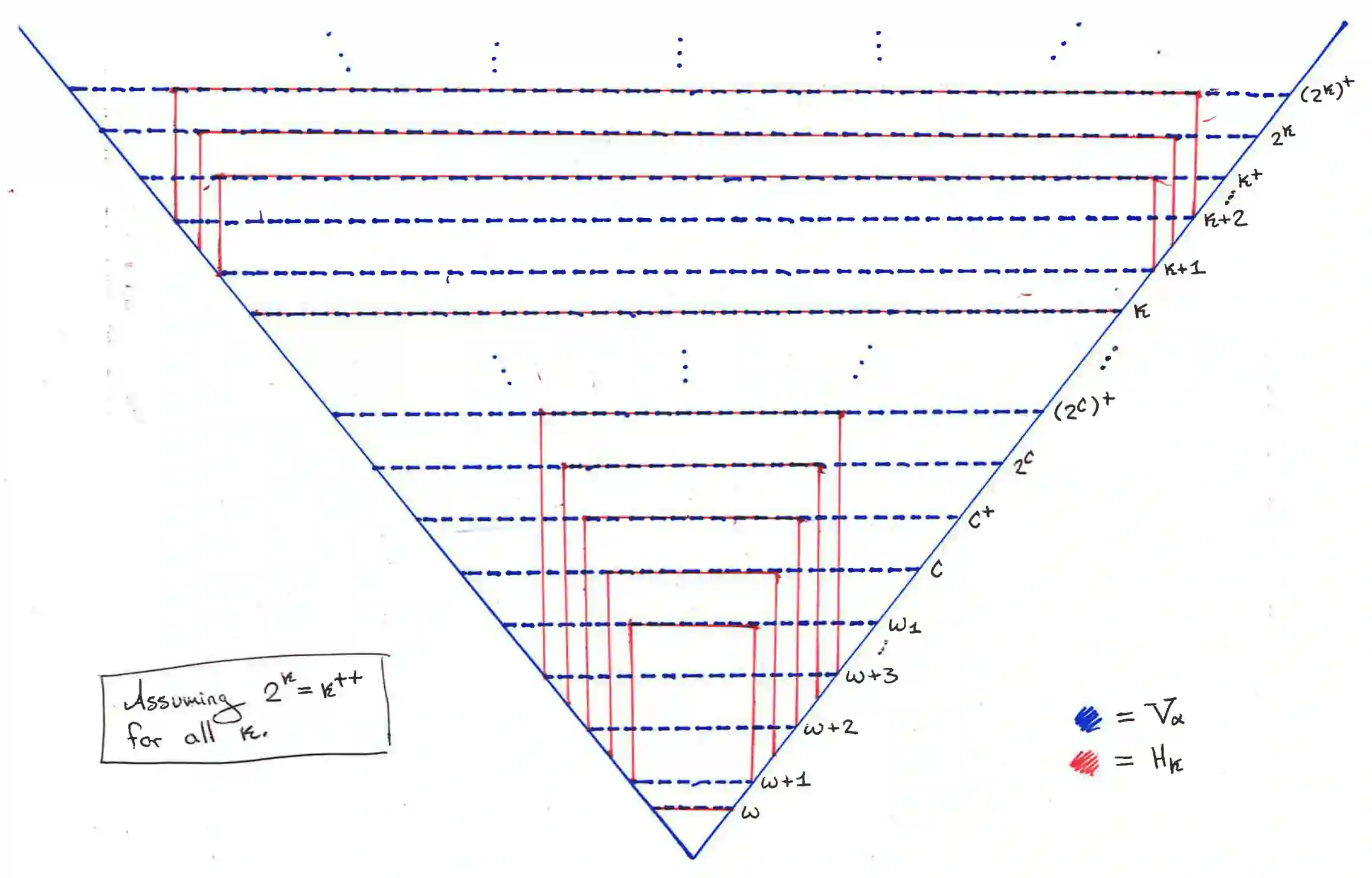
Let’s picture the relationship between the $V_\alpha$'s and the $H_\kappa$'s. To make a coherent picture we have to agree on how the cardinal exponent function behaves in our universe. I’ve arbitrarily chosen that $2^\kappa=\kappa^{++}$ here. The picture in general will be similar though, but the larger $2^\kappa$ is, the “narrower” the $H_\kappa$'s become. Also, $\kappa$ in the picture is meant to be an inaccessible cardinal — hopefully this overloading of the use of “$\kappa$” isn’t too confusing.
So far so good. Now, let’s have a look at the initial segments of $L$. We of course still have the relativised hierarchies $V_\alpha^L$ and $H_\kappa^L$ (for $L$-cardinals $\kappa$), but $L$ has its own two special hierarchies: the $L_\alpha$'s and the $J_\alpha$'s.
The $L_\alpha$'s look like they’re simply the $L$ version of the rank initial segments. We again set $L_0=\emptyset$ and we then set $L_{\alpha+1}$ to be all definable subsets of $L_\alpha$, with parameters from $L_\alpha$. The difference here is that we keep getting new subsets of earlier stages: $L_{\omega+10}$ will contain new subsets of $L_\omega$. This continues until we reach the next cardinal, so that it isn’t until we reach $\omega_1$ that we stop adding subsets to $L_\omega$.
When we are at cardinal stages though, then we’re simply back at the $H_\kappa$ hierarchy: $L_\kappa=H_\kappa^L$, so we can see the $L_\alpha$'s to give the missing fine-grained pieces to the $H_\kappa$ hierarchy. Also, since GCH holds in $L$ we do get that $L_\kappa$ has size $\kappa$. This holds in general: $L_\alpha$ has size $|\alpha|$.
A downside to this hierarchy is that the hierarchy is mostly only well-behaved at limit stages. Most formulas we’d like to work with in an $L$-setting, like checking if a set is of the form $L_\alpha$, or how two sets are related in the constructibility ordering, or even $V=L$, are only absolute to $L_\alpha$ when $\alpha$ is a limit ordinal.
This is a first motivation for Jensen’s hierarchy $J_\alpha$, whose initial segments always have limit height. Here we again start with the empty set, at limit stages we take unions, but we take successor stages $J_{\alpha+1}$ to be the closure of $J_\alpha\cup\{J_\alpha\}$ under all the rudimentary functions. Closing something off under (finitely many) functions takes $\omega$ stages, so here we then get that the height of $J_{\alpha+1}$ is the height of $J_\alpha$ plus $\omega$, so that in general we get that $J_\alpha$ has height $\omega\cdot\alpha$.
A notable feature of the Jensen hierarchy is that $J_{\alpha+1}$ agrees with $L_{\alpha+1}$ below height $\alpha+1$ — all new sets are added on top. The main motivation for working with the Jensen hierarchy rather than Gödel’s is more than the absolute properties however: the Jensen hierarchy allows a fine structural analysis, making it the hierarchy of choice for inner model theorists.
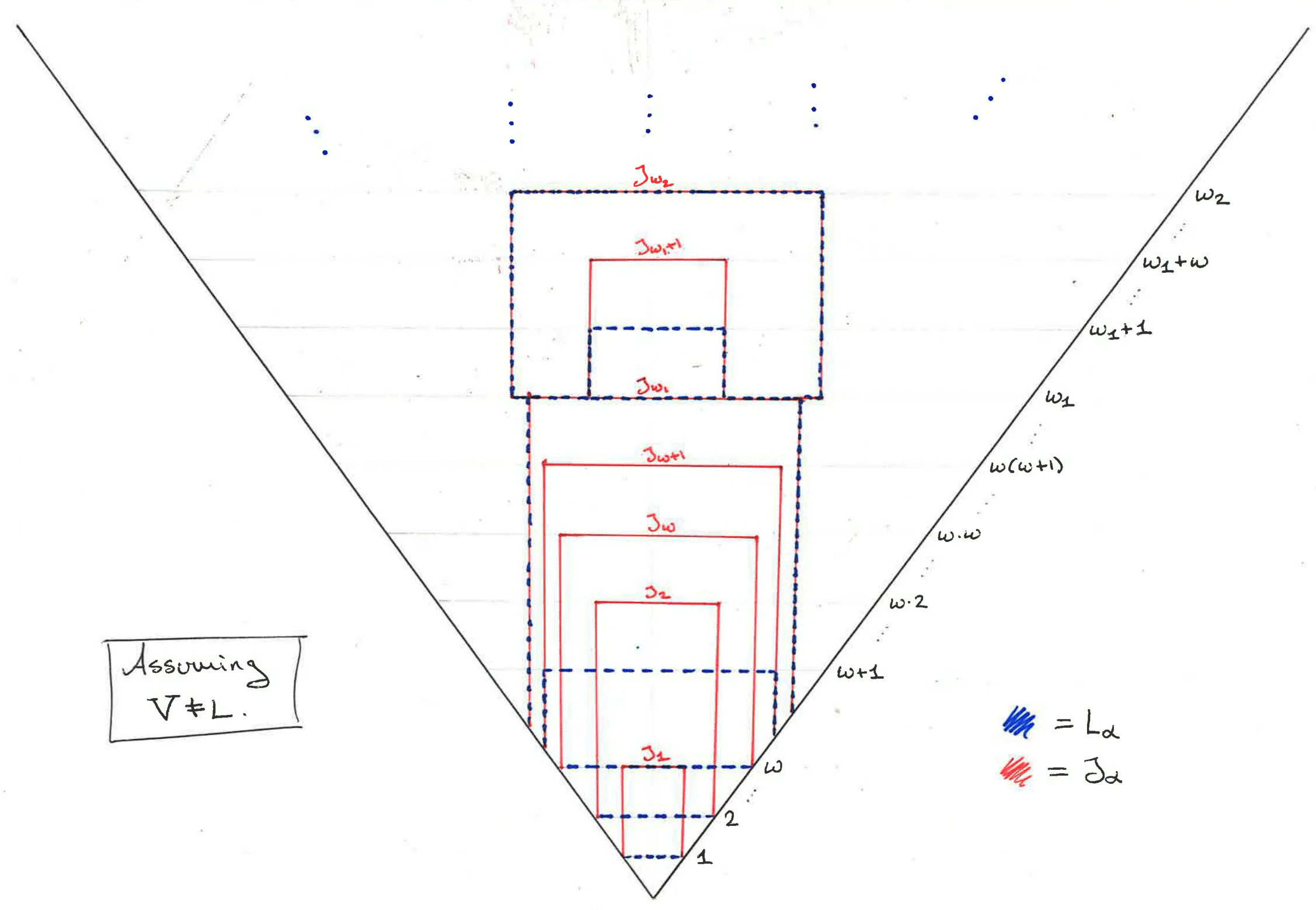
Here’s a picture of the two $L$-hierarchies, situated inside another universe $V$ (here we assume $V\neq L$ because, why not). Note here that the Jensen hierarchies are really just the Gödel hierarchy “stretched upwards”, and that they agree whenever the index is a cardinal.