The Ideal Kind of Saturation
Posted on March 1, 2018
A long time ago I made a blog post on the fascinating phenomenon of generic ultrapowers, where, roughly speaking, we start off with an ideal $I$ on some $\kappa$, force with the poset of $I$-positive sets and then the generic filter ends up being a $V$-measure on $\kappa$. If this sounded like gibberish then I’d recommend reading the aforementioned post first. The cool thing is that we can achieve all this without requiring any large cardinal assumptions! We’re not guaranteed that the generic ultrapower is wellfounded however, but if it happens to be the case then we call $I$ precipitous. We have a bunch of other properties these ideals can satisfy however, usually involving the term ‘saturation’. What’s all that about and what’s the connection to precipitousness?
Before we start, let’s try to get a bit of motivation. First of all, precipitousness is equiconsistent with a measurable, as witnessed by the following result which is Theorem 22.33 in Jech.
Theorem.
- If $\kappa$ is a regular uncountable cardinal that carries a precipitous ideal, then $\kappa$ is measurable in $L[A]$ for some set $A$;
- If $\kappa$ is a measurable cardinal, then $\omega_1$ carries a precipitous ideal after forcing with $\text{Col}(\omega,{<}\kappa)$.
Even though the two notions have the same consistency strength they by no means have the same direct implication strength, in that one can for instance have a precipitous ideal on a successor cardinal, as witnessed in (2) above. To bridge this gap we use the notion of saturated ideals. To save a few pixels we’ll adopt the following assumption.
Now, here’s a definition.
Definition. Let $\kappa$ be a regular uncountable cardinal and $I$ an ideal on $\kappa$. Then the saturation of $I$, denoted $\text{sat}(I)$, is the least ordinal $\gamma$ such that the forcing poset of $I^+$-positive subsets of $\kappa$ has the $\gamma$-chain condition.
With this notion at hand we say that $I$ is $\lambda$-saturated if $\text{sat}(I)\leq\lambda$. Tarski ('45) proved that $\text{sat}(I)$ is always regular, so we can assume $\lambda$ to be regular.
Okay, I now want to argue that we can interpret the amount of saturation of an ideal on $\kappa$ as “how far from being a measurable $\kappa$ is”. First of all, note that $\kappa$ is measurable if and only if there’s a a 2-saturated ideal on $\kappa$, since that forces the dual filter to be an ultrafilter and so we got a non-principal $\kappa$-complete ultrafilter on $\kappa$. At the other end of the spectrum, note that every ideal on $\kappa$ will be $(2^\kappa)^+$-saturated, simply for size reasons. This means that we eventually lose the precipitousness along this spectrum. But where? It turns out that we can get incredibly close to the end of the spectrum and still retain precipitousness.
Theorem. Let $\kappa$ be a regular uncountable cardinal. Then every $\kappa^+$-saturated ideal on $\kappa$ is precipitous.
Nowadays it is custom to say that the ideal is saturated if it’s $\kappa^+$-saturated, so we’ll adopt that convention here. I won’t give a proof of the above theorem here, but an important ingredient is that it’s possible to reason directly, in V, about the generic ultrapower: there are collections of functions in V which correspond to generic functions defined on a measure one set, which are precisely the representatives for elements of the generic ultrapower. We can even define a relation between these collections of functions that correspond to membership between the corresponding elements of the ultrapower! For more detail see section 22 in Jech.
Another notion which is used frequently when it comes to ideals like this is presaturation. Since $I$ being saturated is the same thing as the $I^+$-forcing having the $\kappa^+$-chain condition, this means in particular that all cardinals $\geq\kappa^+$ are preserved in the generic extension. We can then weaken this and say that $I$ is presaturated if it’s precipitous and $\kappa^+$ is preserved in the generic extension. Assuming precipitousness in the definition might seem like cheating and indeed isn’t always included, but Foreman ('10) shows that if $2^\kappa=\kappa^+$ then presaturation does imply precipitousness (even more, the generic ultrapower is closed under $\kappa$-sequences in the extension).
Now, I claimed that the route from measurability to precipitousness is a spectrum where we gradually lose more and more direct implication strength, so let’s delve into what happens as we’re walking along this spectrum. When we move from being measurable (= 2-saturated) to $\aleph_1$-saturated then we lose measurability in general: namely, either $\kappa$ is measurable or $\kappa\leq\mathfrak c$ and it’s real-valued measurable. As we traverse through the $\lambda<\kappa$ we still retain the tree property at $\kappa$, but as soon as we get to $\kappa$-saturation Kunen ('78) showed that if $\kappa$ isn’t measurable there’s a $\kappa$-Aronszajn tree and so the tree property fails. In fact the tree is even a $\kappa$-Suslin tree, so the $\kappa$-Suslin hypothesis fails as well. We do keep some strength however, as Lemma 22.27 in Jech shows that we’re still stationary (in particular still weakly inaccessible).
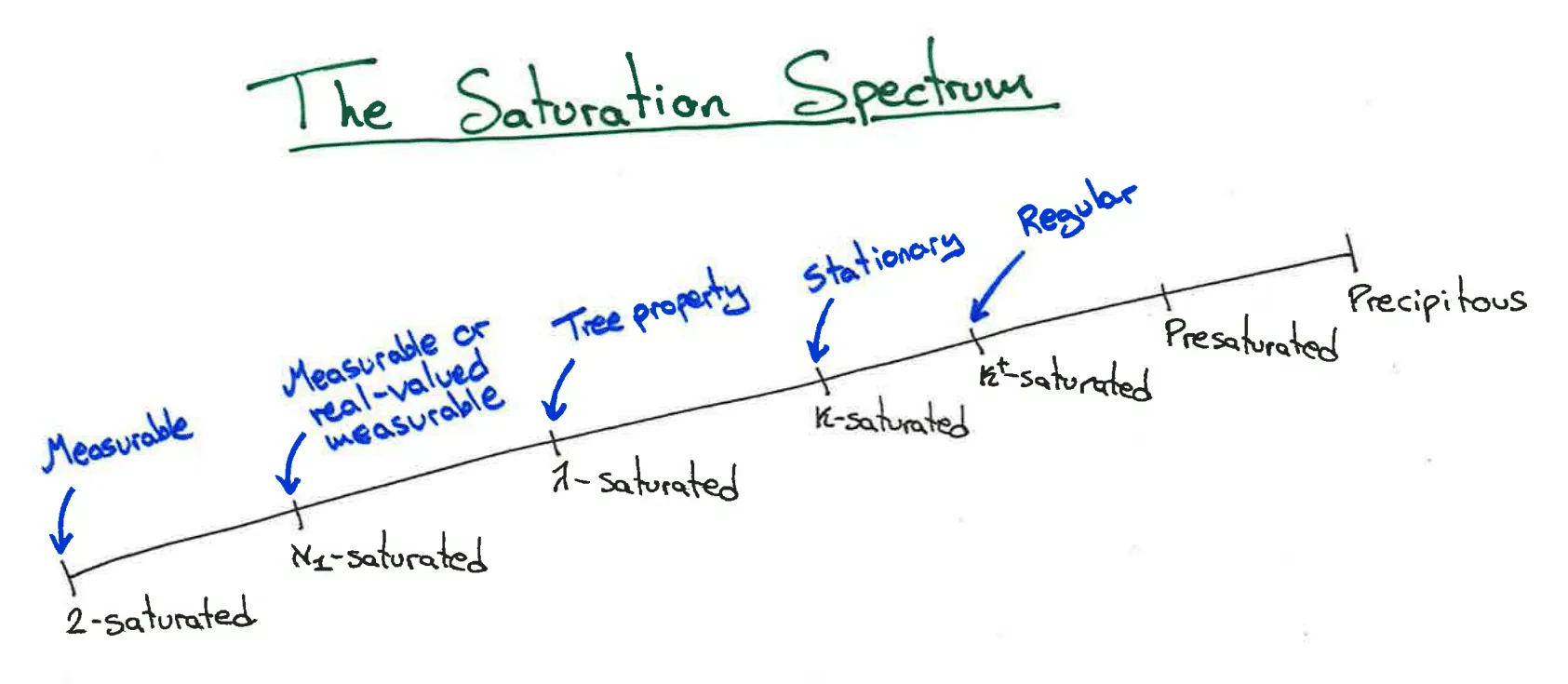
As we approach the finish line, saturation doesn’t even imply that $\kappa$ is a limit cardinal anymore, as Shelah ('98) showed that the non-stationary ideal on $\aleph_1$ can be saturated (Schindler has written up a proof of this result), modulo the existence of a Woodin cardinal. Regularity is something we can’t get rid of however, as this has nothing to do with the saturation but is instead a consequence of $\kappa$-completeness of our ideal, as shown here. This is a necessary requirement as well, as Johnson ('86) showed that if we don’t assume this completeness property then there can exist a precipitous ideal on a singular cardinal.