Projective Understanding via Woodins
Posted on December 18, 2017
I’ve previously covered Woodin’s genericity iterations, being a method to “catch” any real using Woodin cardinals. Roughly, given any countable mouse M and a real x, we can iterate M to a model over which x is generic. An application of this is the phenomenon that Woodins present in mice allows them to be more projectively aware.
This post is part of a series on genericity iterations:
- Genericity Iterations I
- Genericity Iterations II
- Projective Understanding via Woodins
- From Mice to Determinacy
- Projectively Correct Mice
To explain what I mean by this, we need a definition, this one taken from the core model induction book.
Definition. Let $A\subseteq\mathbb R$, M a countable mouse, $\eta$ an uncountable cardinal of M and $\tau\in M^{\text{Col}(\omega,\eta)}$. Then $(M,\tau)$ understands A at $\eta$ if whenever P is an iterate of M and $g\in V$ is $\text{Col}(\omega,i(\eta))$-generic over P then $A\cap P[g]=i(\tau)^g$. We also say that M understands A at $\eta$ if there exists such a $\tau$, and simply that M understands A if there exist such $\tau$ and $\eta$.
If a given set A is understood by M at some $\eta$ then M suddenly has an oracle which can inform it about membership of A, even though A might not be an element of M. Namely, it can ask of a real $x\in\mathbb R\cap M$ whether there exists a $p\in\text{Col}(\omega,\eta)^M$ such that $p\Vdash \check x\in\tau$, where $\tau$ witnesses that M understands A.
The result concerning Woodin cardinals is then the following, essentially saying that the more Woodin cardinals M thinks there are, the more projective sets it knows of as well.
Theorem. Let M be a countable mouse and let $\delta$ be a Woodin cardinal of M. Then whenever M understands $B\subseteq\mathbb R^2$ at $\delta$, M also understands $\exists^{\mathbb R}B$ at any $\kappa<\delta$ which is uncountable in M.
Proof. Let $\tau$ witness that M understands B at $\delta$ and define $\sigma\in M^{\text{Col}(\omega,\kappa)}$ as follows. Let $(q,\rho)\in\sigma$ iff $q\in\text{Col}(\omega,\kappa)$, $\rho\in M^{\text{Col}(\omega,\kappa)}\cap(H_{\kappa^+})^M$ is a name for a real and
$$ q\Vdash\exists p\in\text{Col}(\check\omega,\check\delta): p\Vdash\exists y:(\check\rho,y)\in\check\tau. $$
To show that $\sigma$ witnesses that M understands $\exists^{\mathbb R}B$ at $\kappa$ we may firstly assume $i=\text{id}$ in the definition of understanding, to ease notation. Let $g\in V$ be $\text{Col}(\omega,\kappa)$-generic over M. We have to show that
$$ \exists^{\mathbb R}B\cap M[g]=\sigma^g. $$
We start with the $(\subseteq)$ direction. Let $x\in\exists^{\mathbb R}B\cap M[g]$ and pick $y_0\in\mathbb R$ such that $(x,y_0)\in B$. Now, since $\delta$ is Woodin in M we can form a genericity iteration $j:M[g]\to P$ such that $y_0\in P[h]$, where $h\in V$ is $\text{Col}(\omega,j(\delta))$-generic over P.
Furthermore, we can pick $\text{crit}(j)<\delta$ to be as large as we want in a genericity iteration, so by choosing it sufficiently large we may assume that $\kappa$ and $g$ are fixed by $j$. Because then $P=Q[g]$, where $k:M\to Q$ is the iteration derived from $j$. We thus have the following picture:
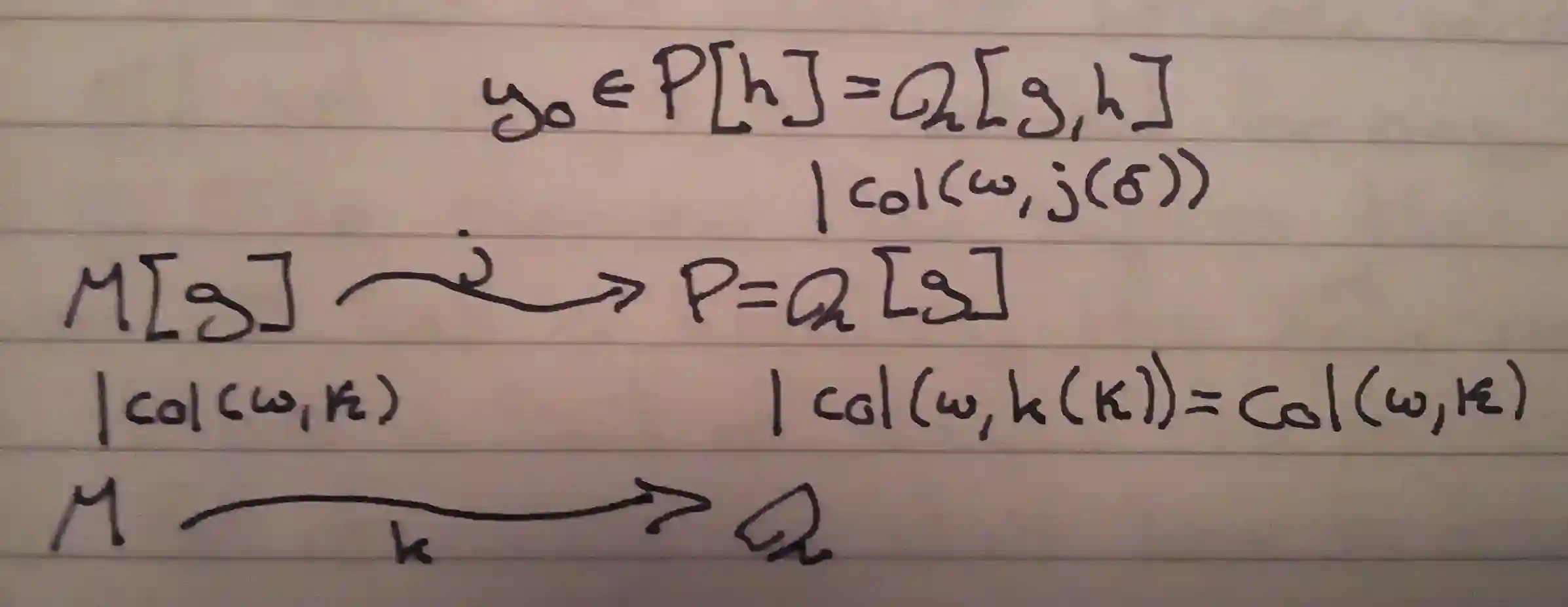
As $\tau$ witnesses that M understands B we have that $j(\tau)^h=k(\tau)^{g\oplus h}=B\cap Q[g,h]$, so that $(x,y_0)\in j(\tau)^h$. This means that $Q[g,h]\models \exists y:(x,y)\in j(\tau)$, implying that $Q[g]\models\exists q:q\Vdash\exists y:(\check x,y)\in j(\tau)$ and then elementarity of $j$ yields that
$$ M[g]\models\exists q:q\Vdash\exists y:(\check x,y)\in\tau, (\dagger) $$
concluding that $x\in\sigma^g$ by construction of $\sigma$. As for the $(\supseteq)$ direction, if $x\in\sigma^g$ then $(\dagger)$ holds, so that $Q[g,h]\models\exists y:(\check x,y)\in j(\tau)=B\cap Q[g,h]$, i.e. that $x\in\exists^{\mathbb R}B$ and we’re done. QED
Note that being understood is closed under negation, so that if $\exists^{\mathbb R}B$ is understood then so is $\forall^{\mathbb R}B=\lnot\exists^{\mathbb R}\lnot B$. Also note that since $\Sigma^1_1$ sets of reals are absolute between mice, every $\Sigma^1_1$ set is understood by any M and $\eta$. By assuming we got a Woodin lying around we can then catch real parameters, making sure that this is still true for boldface $\bf\Sigma^1_1$ sets of reals and hence also for boldface $\bf\Sigma^1_2$ sets by the above Theorem.
In particular, this means that $A\cap M\in M$ for every $\bf\Sigma^1_2$ set A. The theorem then implies that whenever M has $n<\omega$ Woodins then this holds true for $\bf\Sigma^1_{n+1}$ sets, and that if it has a limit of Woodins then it’s true for all projective sets. This is not quite as strong as being projectively correct, as we might have projective sets which have empty intersection with M. To ensure correctness we need something stronger, called Suslin capturing, which we’ll cover at some later point.
But of course we don’t have to restrict ourselves to the projective hierarchy. Whenever M understands any class $\Gamma\subseteq P(\mathbb R)$, Woodins present inside M will ensure that M can reason about the corresponding “$\Gamma$ projective hierarchy”.